Battery Modeling with SIMBA
Download Python Library requirements
This python script proposes an implementation of the Tremblay's model described in 1.
Battery Model
The battery model considers following equations:
where:
- R_{int} is the constant internal resistance,
- OCV is the Open-Circuit Voltage,
- R_{pol} a polarisation resistance.
Info
This model uses a filtered current (i_{filtered}) flowing through the polarisation resistance, to model the slow dynamic behaviour of the voltage for a current variation. This filtered current is obtained by filtering the battery current i_{batt} through a filter with a time constant T_f which is set to 30 s by default.
Open-circuit Voltage (OCV) and polarisation resistance (R_{pol}) both depend on the State of Charge (or State Of Discharge). The OCV is given by:
Whereas R_{pol} depends on the charge / discharge mode.
In discharge, it is given by:
In charge, the polarisation resistance increases until the battery is almost fully charged. It is given by:
where:
- soc is the state of charge [0, 1],
- sod is the state of discharge (sod = 1 - soc),
- E_0, A, B, K are empirical parameters to be defined to fit experimental ,
- soc_{limit} is a constant introduced here to allow the mathematical definition when soc = 0 and has been set to 0.005 here.
Note
The temperature is assumed to be known and set, thus the model here does not depend on it.
Extraction of Model Parameters
This step aims to determine the parameters of the battery voltage expression (written above) from a typical (v, sod) discharge curve or for a typical set of several discharge curves for different current rates. It uses the curve_fit function (based on non-linear least squares) from Scipy.optimize module.
The principle is simple and an extract of the code is shown below:
- the function
get_battery_voltageis defined to compute the battery voltage from model parameters E_0, A, B, K, R_{int} and the battery current i_{batt}, - the
curve_fitfunction is then used to determine parameters to fit the experimental data, data_sod, data_current_rate and data_voltage.
def get_battery_voltage(XY, Eo, A, B, K, Rint):
    sod, current_rate = XY
    soc = 1 - sod
    soc_limit = 0.005
    ocv = Eo + A * np.exp(-B * (1 - soc)) - K * (1 / (soc + soc_limit) - 1)
    return ocv - Rint * current_rate - K / (soc + soc_limit) * current_rate

min_param = [2, 1e-9, 1e-9, 1e-9, 1e-9] # lower bounds for E0, A, B, K, Rint
max_param = [4.1, 1, 40, 1, 10] # upper bounds for E0, A, B, K, Rint

[Eo, A, B, K, Rint], _ = curve_fit(get_battery_voltage, (data_sod, data_current_rate), data_voltage, bounds=(min_param, max_param))
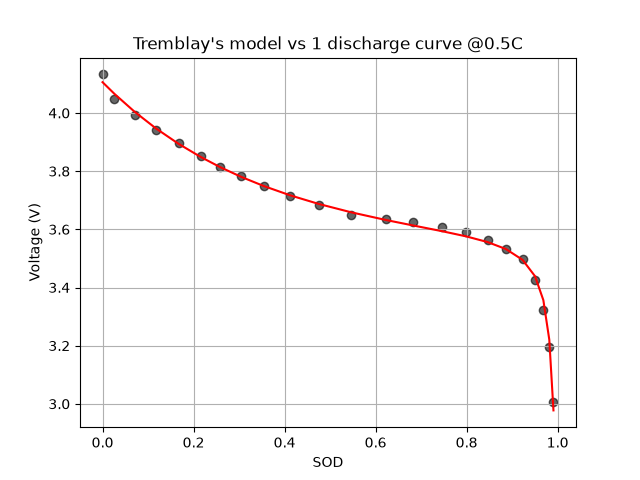
The figure below shows experimental data and model outputs where the parameters have been extracted to fit to a single discharge curve at a current rate of 0.5C:
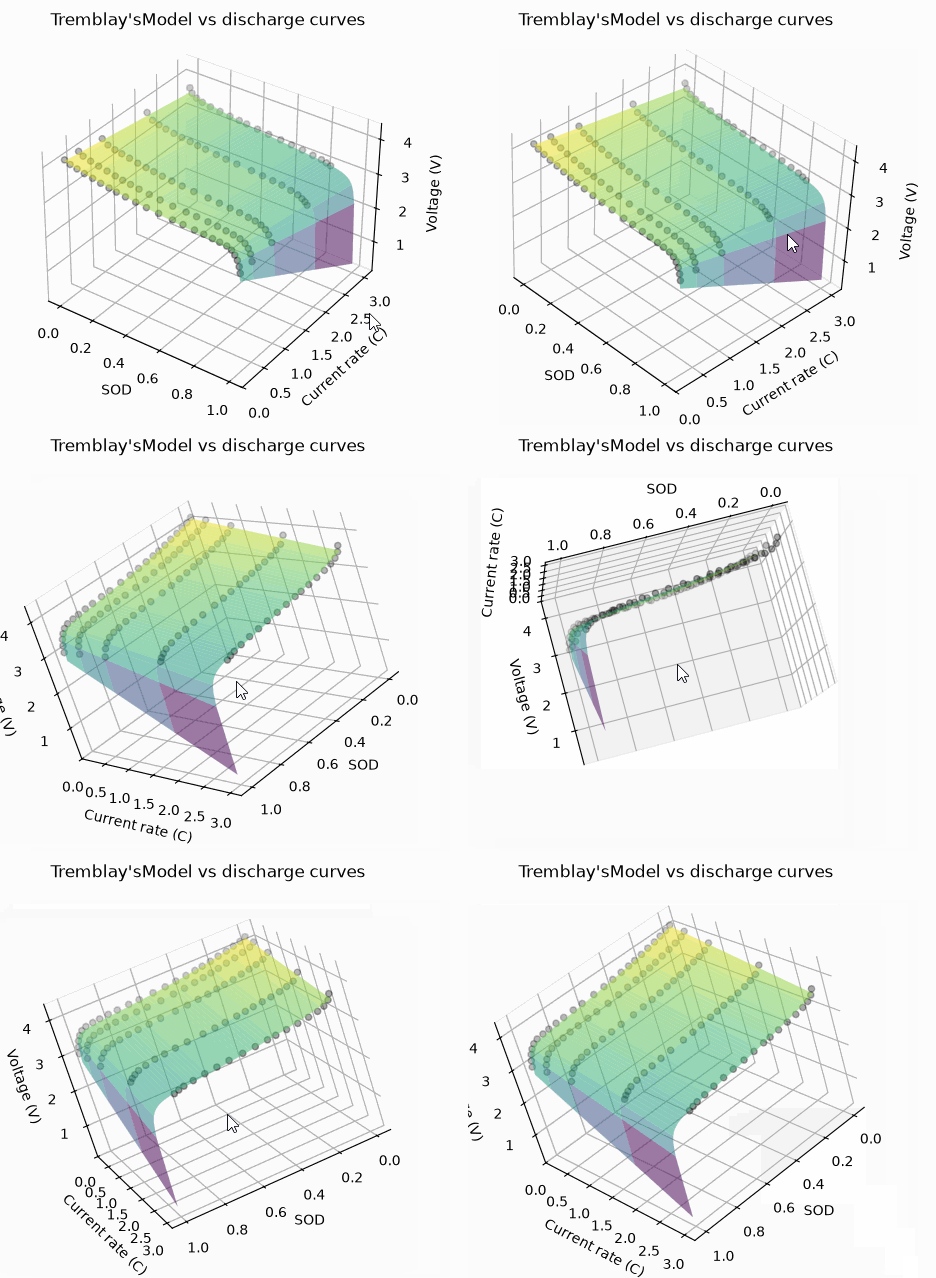
As mentionned above, it is also possible to extract the model parameters to fit a surface which gathers all discharge curves, as shown below:
Implementation of the battery model
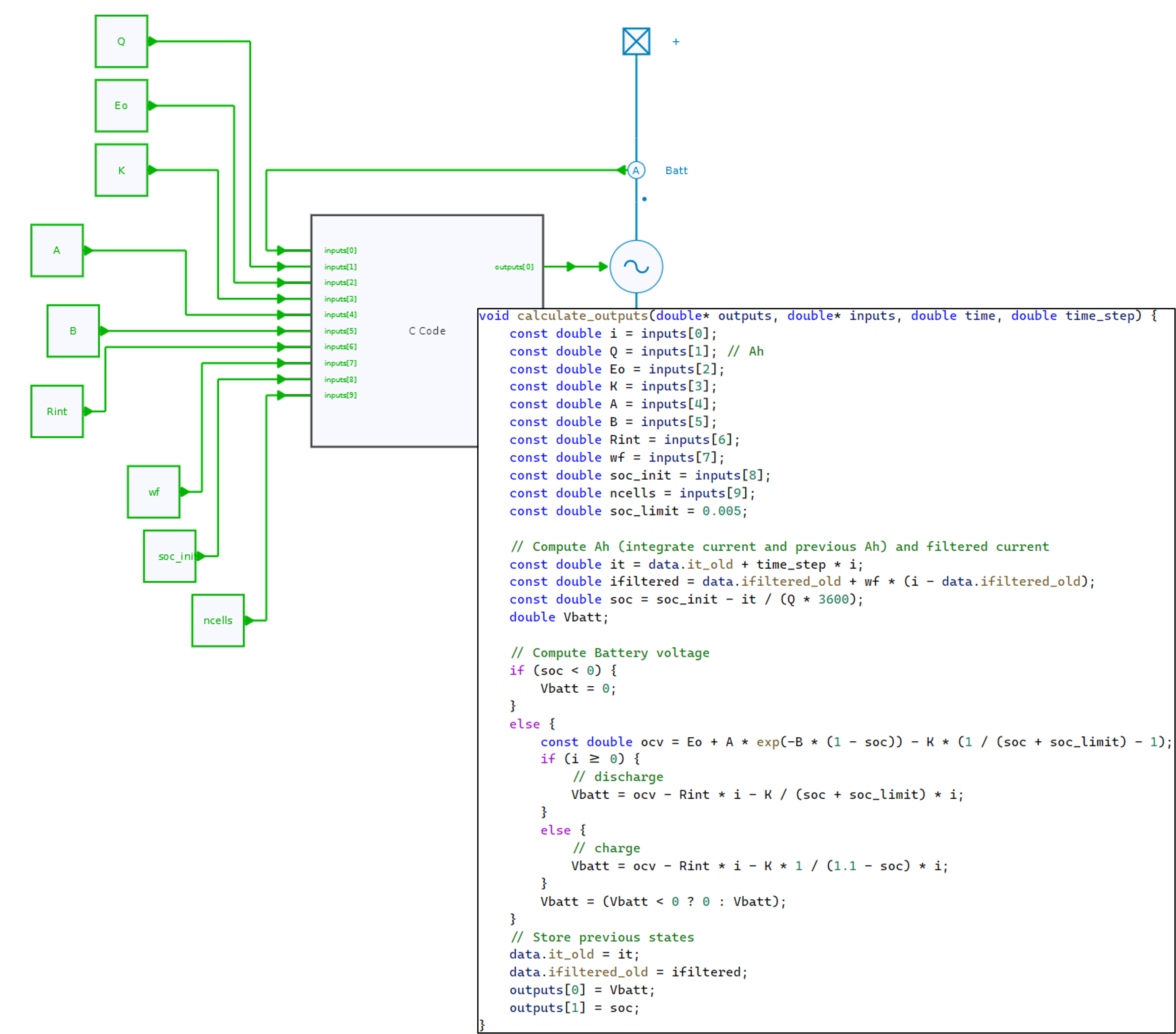
The figure below shows the proposed implementation in SIMBA using a C-code block.
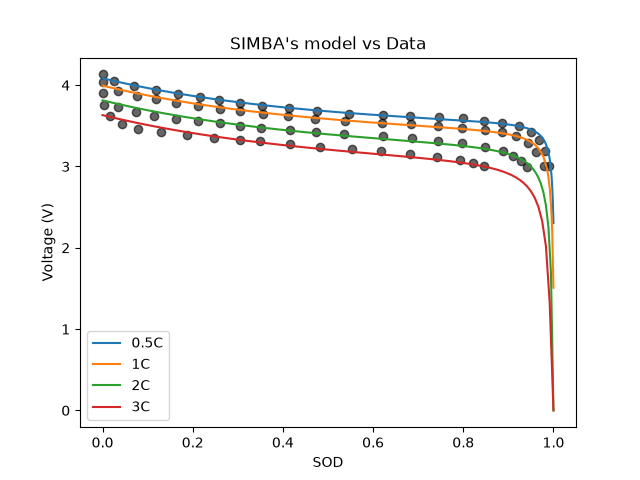
The figure below shows the model results vs the battery data for the different discharge current rates.
-
Tremblay et al., "Experimental Validation of a Battery Dynamic Model for EV Applications, World Electric Vehicle Journal Vol. 3 , 2009, https://dx.doi.org/10.3390/wevj3020289. ↩